I cleaned out a closet recently. That statement doesn’t adequately express the magnitude of the undertaking. This was a closet in my office/studio into which I would toss things when I couldn’t figure out where else to put them. I’d been operating in this manner for five or six years, and the closet had finally reached a sort of critical mass such that nothing more could be put into it, and nothing could be removed from it without a good deal of wrestling. Much of the contents seemed to be bound together with cables: audio cables (including instrument cables, mic cables, and eight-channel snakes of both the balanced and unbalanced variety), MIDI cables, RS-232 cables, AC cables, SCSI cables, VGA cables, Macintosh ADB cables, Ethernet cables, RJ-11 phone cables, and even the cable for the Lexicon Core Studio interface which I discarded some time ago.
I got rid of a lot of old computer stuff, including a 2x(!) CD-ROM(! yes, no writing capability) drive dating from the days that CD-ROM drives had those annoying little caddy things and were housed in their own cases. As I threw out dozens of yards of Mac ADB and serial cables (with their funny little mini-DIN-8 connectors) and SCSI cables and adapters (including an infamous “Weird-30” adapter used by some PowerBooks) I reflected about how much electronics junk Apple had created in the world with their decisions to “think different” and use strange connectors rather than the ones that were already established (such as the DB-9 for serial ports).
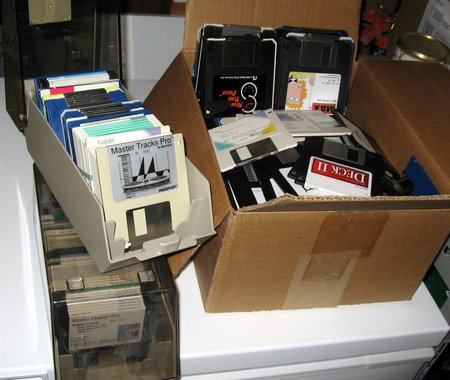
In terms of volume, the largest amount of stuff I discarded was 3.5″ Mac floppy discs. I’d had most of these stashed on a shelf for over 10 years, untouched, retained on the “just in case I need them someday” pack-rat mentality. I decided that if that day hadn’t arrived in over a decade, it probably wasn’t going to arrive at all–particularly considering that I no longer have any pre-G4 Macintoshes on hand. I think I filled two grocery bags with the things. Here’s a subset:
They provided little reminders of my computing past. This trio provides a nice representation:
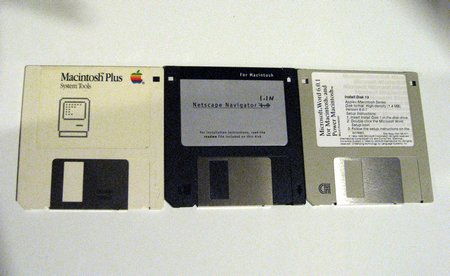
On the left we have the “System Tools” disc from my first Mac. That was from 1986, when you could fit the entire MacOS and some utilities onto one 800K floppy. Next to it is Netscape Navigator, probably from around 1999ish, at a guess. Yes, kids, there was a time in which you could obtain a web browser on a physical medium rather than downloading it from the web. (Why? Well, it’s kind of a long story. Fetch me my Geritol and I’ll tell you.) On the right is MS Word version 6. The label says “Install disc 13”. Remember when you had to stuff a dozen floppies into your machine to install an app? I imagine that version 6 was the last version of Word to ship on floppies rather than CD-ROM.
The discs that I lingered over the longest were the master discs for music software. Many of these were so-called “key discs” which meant that they served as the copy-protection mechanism for the (often fairly expensive) software that was contained on them. They usually permitted you to install the software only a few times, and getting them replaced if they failed could be something of a chore. (Yes, it was my experiences with some of these discs that contributed to my somewhat infamous disdain for PACE. These key discs were the predecessor of the iLok.) Hence their value was disproportionately much larger than that of most 3.5″ floppies, and one tended to keep them in special storage containers on a shelf, safely out of harm’s way. I assembled a small gathering for a final photo:
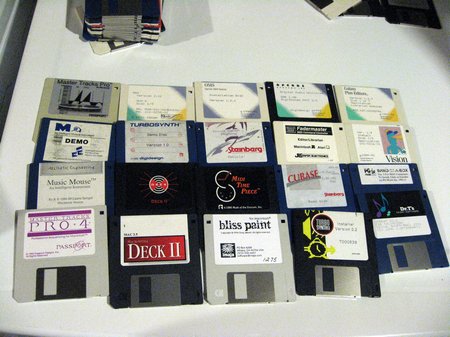
From left to right, back row first: Master Tracks Pro, my first sequencer and possibly the first commercial music software I ever purchased; the first version of Max published by Opcode (dated 1990); OMS, which I won’t even try to explain–you had to be there; the Digidesign Audio Utilities as published by Opcode, system software for their pre-Pro-Tools DSP hardware; and Galaxy Plus Editors, the patch librarian/editing software for numerous MIDI synths. Next row: a demo disc of M, one of David Zicarelli’s first products and still available from Cycling ’74 (I think); a demo disc of Turbosynth, Digidesign’s non-real-time but extremely cool software synth; Steinberg’s ReCycle, the genesis of loop slicing written by the guys who went on to form Propellerheads; editing software for a JL Cooper MIDI fader box; and a very early version of Opcode’s Vision sequencer. Bear in mind that none of the sequencers shown here could record or play audio–this was strictly MIDI sequencing we’re talking about. Next row: Music Mouse, a sort of early “intelligent instrument”/software performance thing written by Laurie Spiegel (whom I spoke to on the phone at some point after buying it); Deck, as published by OSC, the first(?) multi-channel recording app for the Mac; the driver software for the MOTU MIDI Timepiece, the first(?) multi-port Mac MIDI interface; a demo version of Cubase (undoubtedly pre-VST, i.e. no audio); and Band in a Box (don’t ask) Front row: a later verson of Master Tracks Pro which still didn’t have audio; Deck, as published by Macromedia after they acquired it from OSC and before someone else acquired them; Bliss Paint, a sort of abstract animation app that involved scripting sequences of patterns–very cool but fatally flawed because the author didn’t tie the timing to any sort of hardware reference so your animations ran completely differently depending on how fast your hardware was; version 2.2 of Turbosynth, now almost real time because it could use an Audiomedia II card for doing the DSP; and UpBeat, another David Z. creation, as published by Dr. T’s who acquired it from Intelligent Music. (I had discs for it from Intelligent music on hand also.)
In other words, my pack-rat stash of floppies represented a lot of history from the music software world. It was kind of hard to let it go. After all, these programs were not only my tools of musical expression (more or less) but also in some sense the inspiration for Audio Damage and its products. Happily, some of them went to a good home: Turbosynth, UpBeat, and a couple other mutual old favorites are on their way to Chris, where they can sit on his shelf near his alphaSyntauri system.

Sniff, I still miss Opcode.
>>Remember when you had to stuff a dozen floppies into your machine to install an app? <<
Sure, only now I insert DVD #4. Guess you don't buy many massive sample libraries.
Cool photos BTW. 🙂
Opcode made some great stuff. Switching from Studio Vision to Cubase wasn’t much fun at all, even though the last couple of releases of Studio Vision weren’t entirely stable.
No, I don’t buy many massive sample libraries. I’ve always been more synthesizer-oriented than sample-oriented, but then I don’t do film scores and stuff.