Ramen originated in China but it’s a big deal in Japan. This might be faintly surprising since ramen’s main virtue in the eyes of many Americans is its low price. Cheap, instant ramen exists in Japan also, but here the appreciation of ramen is defintely not restricted to less-affluent college students.
One dramatic illustration of this point is the existence of the ramen museum in Yokohama, which we visited on April 5. The ramen museum has a full-sized reproduction of a portion of Tokyo from 1958, including eight or so ramen restaurants. It looks like this:
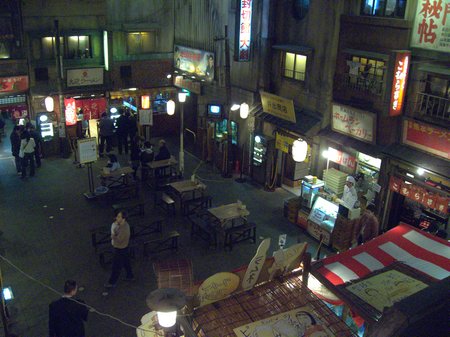
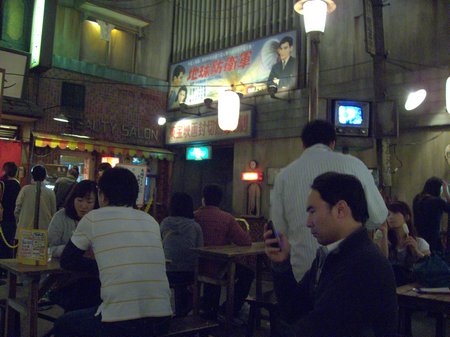
[I promise that I’ll eventually post these photos and many more on my Flickr site so that you can see them at full resolution.]
Each restaurant features a different primary seasoning (e.g. soy sauce, miso) and different additions (e.g. chicken, pork). Based mostly on the photos of the dishes on the menus in front of each restaurant, I ended up eating a bowl of salt-flavored ramen with thin slices of pork. Yes, salt-flavored. It’s difficult to describe, but it tasted like salt without particularly being what one would describe as salty. Don’t ask me how they managed to do that. If you’ve had sea salt and have noticed the difference in flavor relative to regular table salt, that will give you some insight. The other predominant flavors were sesame and pepper. It was quite good and quite filling, and ended up being both lunch and dinner for me.
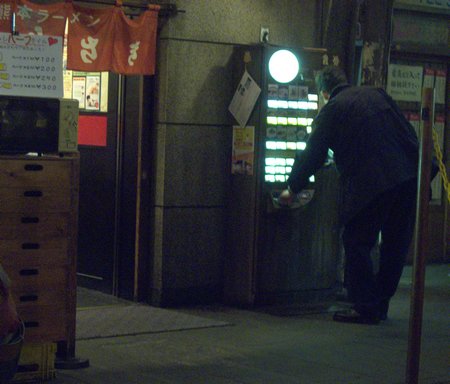
Speaking of the photos on the menus, it’s possibly worth describing how one orders ramen in ramen shops here, since it was something of a mystery to me at first. Outside the shop is a machine mounted on the wall that has photos of the various dishes with their names beneath, and a bunch of buttons with the names and prices on them. You put money into the machine (or smack it with your cool RFID-laden Pasmo card, if you’re a local) and press the button(s) for the dish(es) you want. The machine dispenses a little ticket, which you take inside and hand to either the person behind the counter or the friendly waitperson who greets you with a bow. It’s all simple enough if either you read Japanese, or if the machine happens to have the buttons immediately adjacent to the corresponding photos. If not, you have to match up the katakana beneath the photos with the katakana on the buttons. You can guess which situation arose the first time I used one of these machines. Here I am at the machine I used in the ramen musem:
While I ate, I watched the locals, many of whom were businessmen on their lunch breaks, and picked up few points about eating ramen. Common technique involves holding the chopsticks in your right hand and a spoon in the left. It’s fair game to scoop up some of the soup with the spoon and then add other things to it with the chopsticks before ladling the result into your mouth. Picking up the bowl and drinking from it directly is also seemingly not a transgression of etiquette. Slurping is (somewhat famously) mandatory, and it’s harder to do than one might think if one has been raised to not make slurping noises while eating. I’ve been striving to improve my slurping technique. I’m still somewhat baffled by how one avoids flinging liquid all over the table, ones face, and anyone else nearby when the ends of the noodles achieve sufficient velocity to whip around as they near your mouth. I think that the answer is that one leans forward over the bowl so that the noodles travel in a straighter path into ones mouth than they would if one sits upright in proper Western dining posture.
I was going to write about our ramen dinner at Ippudo with Rafael next but we have to head to the train station shortly. We’re about to travel from Kobe to Matsue, where we’ll stay for two nights before going to Kyoto. Perhaps I’ll write about Ippudo while on the train.

Very evocative photos – a bit Blade Runner-esque.
Sounds like a great adventure.
It was a bit Bladerunner-esque, minus the technology (and rain). The detail in Bladerunner that I always think of while in Tokyo is the sounds that the crosswalk signals make. You don’t really notice them in the movie but they’re instantly recognizable when you hear them in person.
I have some more photos of the museum which I’ll post when I start putting stuff up on Flickr.
“I’m still somewhat baffled by how one avoids flinging liquid all over the table, ones face, and anyone else nearby when the ends of the noodles achieve sufficient velocity to whip around as they near your mouth.”
THIS.
Also, I’ve actually been to that museum, taken by our suppliers for our/your papers! 😀 They live in Yokohama.
You have nailed the necessary posture adjustment for soup and noodle slurping! I swear that in southern China, where noodle soup is slurped, the tables are lower so you can get closer to your bowl vs. northern China, where you’re eating rice and/or steamed bread and splashy soup is not so frequent…
Love your posts and pictures!