[If you haven’t already read Part 1, it’s here.]
We’ve been home for a few days now. I wrote most of the following text while flying home. I should mention that Tracie found a factual error in the first part of the story: she did not receive IV steroids in the ER in Tokyo. The doctor decided that pills were enough. (No, that detail doesn’t have much bearing on anything, but sometimes I look back at this blog to refresh my memory, so I might as well make note of that error.)
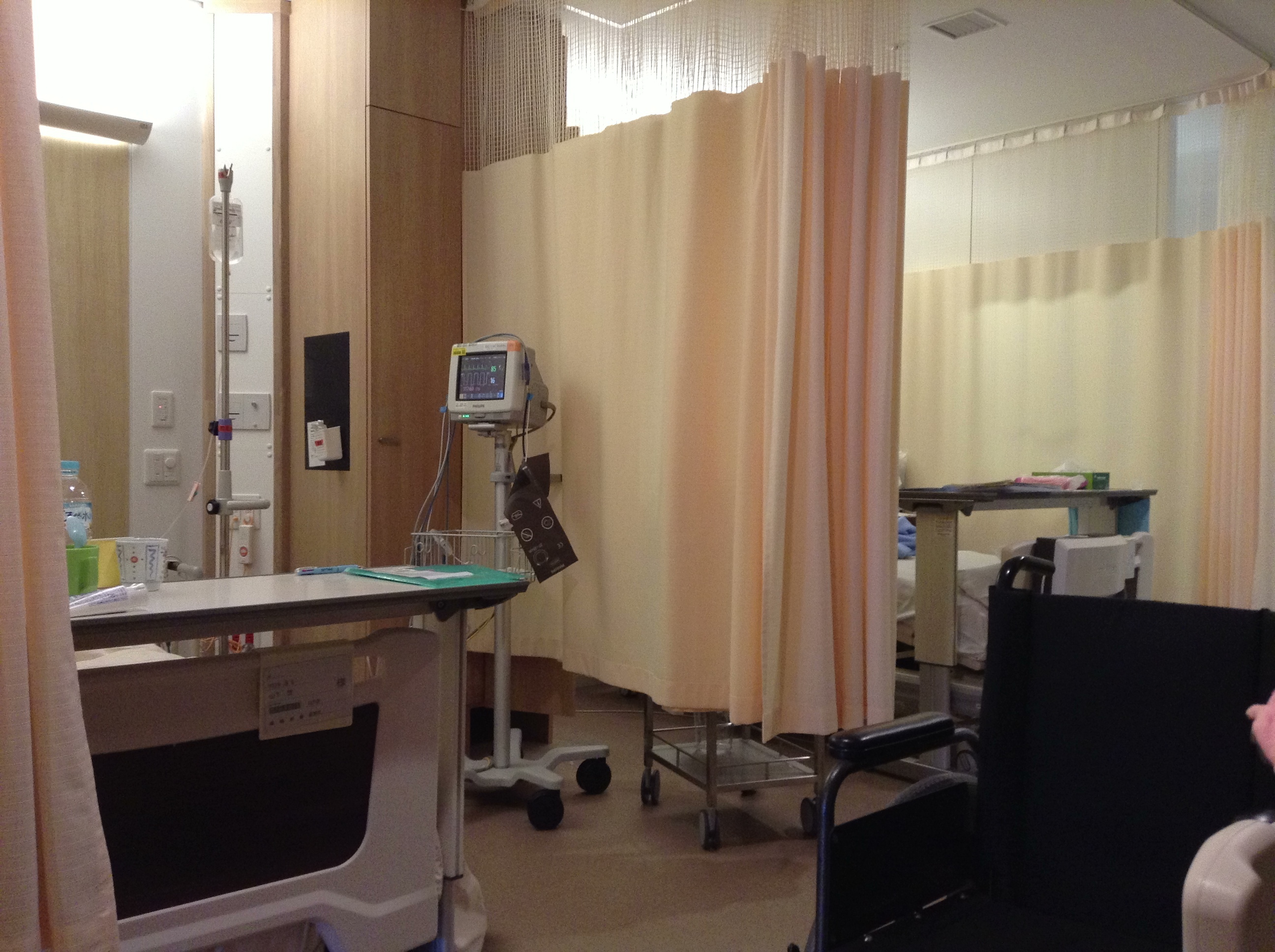
As you might guess, neither of us slept particularly well in the ICU that night. I probably slept better than Tracie–I usually do, regardless of the circumstances–but I woke up suddenly a number of times. I’d lie there listening to machines beeping softly at different intervals and distances and try to think of the sounds as some minimal/ambient installation piece, but the punctuation of occasional groans and nasty coughing kind of ruined the musical possibilities. I’d try to ascertain whether Tracie was awake or asleep without waking her. I helped her get to the restroom once, and later one of the nurses did the same. I must’ve been sleeping pretty well at that point because I didn’t notice her absence. Fortunately the restroom wasn’t far from her bed, but I have to say that shuffling past other ICU residents, in the semi-darkness in the middle of the night, with Tracie trailing the IV stand and wires for various monitors, was kind of strange. It was a far cry from sleeping in the Crowne Plaza Hotel, which is what we were supposed to be doing that evening.
Backing up slightly, the most interesting part of this entire episode is that it was finally determined what was causing these systemic reactions: it was the carbamazepine. It took three trips to the ER (in three different cities) to figure this out because it’s a somewhat rare reaction. Since Tracie has so many other allergies, it was deemed more likely that she was reacting to something else–something she accidentally ate or some environmental factor. On the first occasion, our best guess was that it was some contaminant on the surface of an apple she ate for breakfast. On the second occasion, Dr. Gunshin’s belief was that the skin rash was triggered by sun exposure, because sun sensitivity is common in people taking carbamazepine. Note, however, that the skin rash had actually started some time ago, but nobody who looked at it thought that it was particularly a concern. It wasn’t until the third reaction that everyone agreed that it pretty much had to be the carbamazepine. The timing was too coincidental, Tracie hadn’t eaten anything that she hadn’t eaten previously that day, and a neurologist in the third hospital confirmed that the rash she had on her face and shoulders looked like a carbamazepine reaction. (He didn’t say a whole lot otherwise, at least not directly to us–his English was pretty limited.)
Once it was figured out what was going on, the question was what to do about it. Recall that Tracie was prescribed carbamazepine in the first place because she developed trigeminal neuralgia, which was excrutiatingly painful by the time she sought treatment. Gee, I guess I never blogged about that event. It was a good one, too: things came to a head on the weekend before Christmas. She described it as feeling like having root canals on all of her teeth on one side, simultaneously, without anesthetic. On Christmas Eve, we ended up in a hospital-lab waiting room waiting for blood-sample instructions to be delivered from the on-call neurologist. I ended up driving back and forth across town to get a prescription filled while Tracie was literally doubled over in pain. The first medication, gabapentin, completely threw her for a loop; she saw “space portals opening in the back yard” during the peak. Eventually she saw her regular neurologist and ended up on a low dose of carbamazepine; the initial dose was effective but completely sapped her of her strength. Good times, that Christmas season.
So anyway, the unanimous decision was that Tracie was to stop taking carbamazepine. I use the word “unanimous” because eventually a sort of committee formed around Tracie’s bed, consisting of four doctors with varying degrees of proficiency in English, ranging from limited to almost none (but still far, far better than our proficiency in Japanese, which is negligible). The one who was the most proficient would talk to Tracie and then act as an interpreter for the others, although sometimes one of the others would chime in when they recognized some random word. I’m fairly sure that I cannot accurately convey the anxiety this caused me, to say nothing of Tracie.
Next it was decided that she’d stay in the hospital overnight–a decision that wasn’t unanimous intially but she realized pretty quickly that it was foolish to do otherwise and consented. We had to make sure that the reaction had really been stopped with the steroids; it would’ve been something of a hassle to get back to the hotel and have everything start all over again after the initial dose wore off.
Finally, we decided that we’d go back to Tokyo because the doctor there spoke very good English and hence was better equipped to care for Tracie if the need arose again. Our original itinerary had us staying in Kobe for three nights, then going to Matsue for a few days, then spending a few days in Kyoto, then returning to Tokyo for a night before flying home. Matsue is a smaller city several hours away by train from Kobe on the other side of Japan’s main island. (Kobe itself is three hours from Tokyo by train.) It’s a delightful city in a beautiful setting, but it has fewer English speakers than other parts of Japan and probably less-sophisticated hospitals than the larger cities. Hence it would have been downright stupid of us to go there, given Tracie’s condition. So, we elected to spend our scheduled amount of time in Kobe–two more nights–then return to Tokyo.
Tracie was reluctant to stop taking the carbamazepine without switching to something else to keep her trigeminal neuralgia in check. Eventually the doctors in Kobe prescribed Lyrica, 75mg twice a day. Tracie tried to explain that she reacts very strongly to most medications, and that taking less than the usual dose was probably prudent. The doctors didn’t much like this suggestion, maybe because of a recognized cultural tendency to believe that there’s one particularly correct way of doing something, maybe because they still hadn’t quite come to terms about how to care for a feisty blonde female gaijin who seemingly knew as much about medicine as they did. Fortunately we received the first dose in a blister pack of three 25mg tablets, so Tracie took one and I quietly pocketed the rest.
That was at about 5:15AM the next morning. The agreement was that she’d take the first dose at 5:00AM, the doctor would come by a bit later to assess her condition, and she’d be discharged at 6:00AM if everything was copacetic. 5:00AM came and went without anyone appearing with the Lyrica, so we pointed out to one of the nurses that someone was supposed to supply us with meds. The lack of attention didn’t bode well.
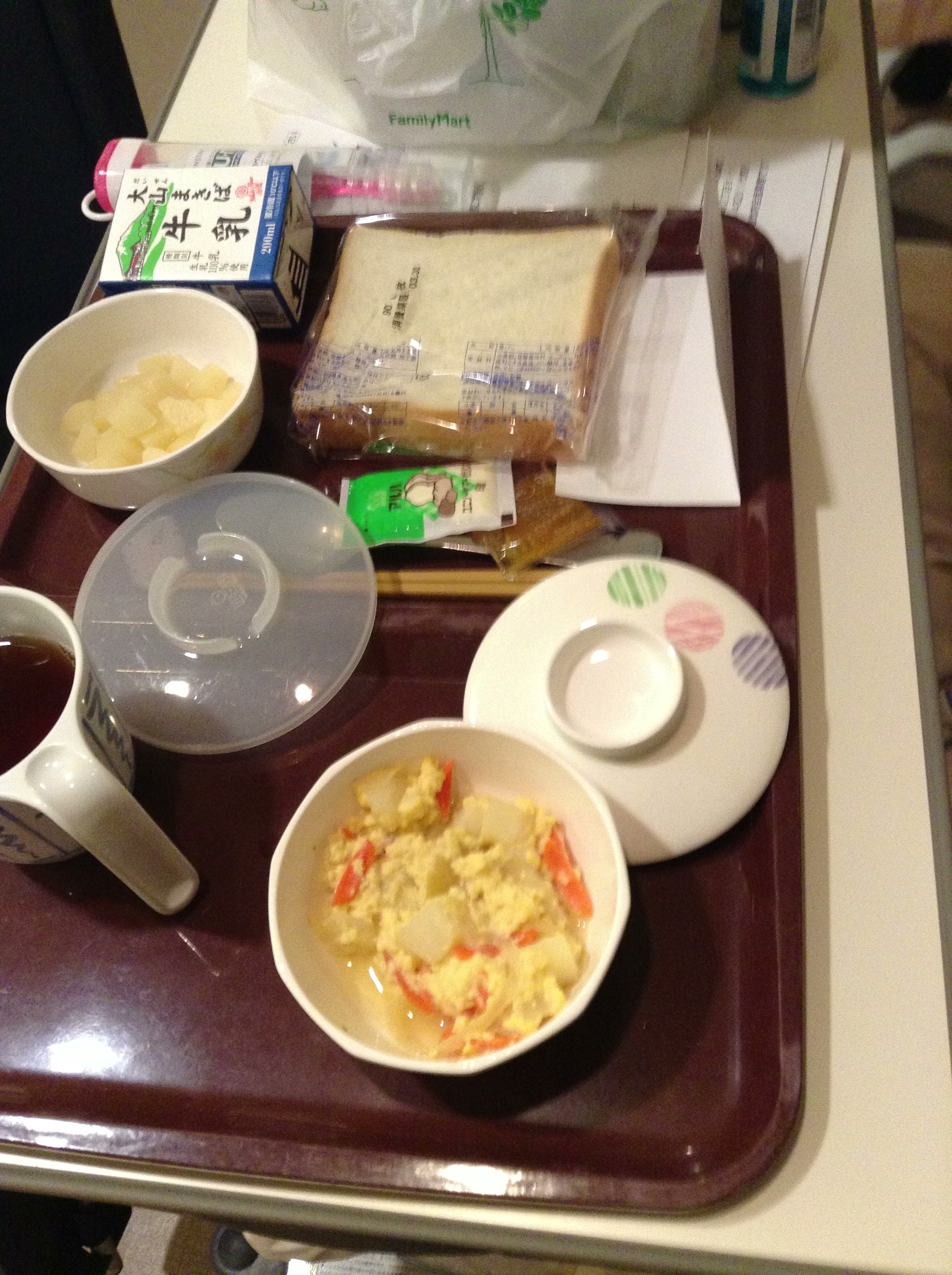
6:00AM came and went with no sign of the doctor. At about 7:00, breakfast–so-called–appeared. Tracie couldn’t eat any of it; some of it could have killed her, some of it she can’t eat because of other non-allergy restrictions. I was quite hungry so I ate the less-awful parts of it.
By 8:00AM the doctor still hadn’t appeared and we more or less ran out of patience. We’d figured out by then that Tracie was fine. We’d also figured out that we had no internet access and no international phone access. This meant that we couldn’t do several things that really needed to be done ASAP, such as contacting Tracie’s neurologist back in the states, contacting our travel agency so that they could arrange accomodations in Tokyo for us, contacting our friends in Kobe who were going to meet us at a train station near their house early that afternoon, and finding some food for Tracie. The latter was arguably the most important: you can’t very well expect someone to recover from a systemic allergic reaction and continue metabolizing the agent that started it if you don’t feed them. I politely cornered the nurse and got out of her that the doctor had put in Tracie’s record that she was to be discharged at noon! Did I say that we had more or less run out of patience? Tracie was definitely in the “more” side of that statement now.
Thus ensued a rather tense exchange. Tracie informed the nurse that we were leaving, regardless of the doctor’s orders and absence. The nurse said that she couldn’t. Tracie said that she most definitely could. The nurse indicated the IV still stuck in Tracie’s arm. (She hasn’t been hooked to the monitors for awhile; nobody bothered to reconnect the wires after her second trip to the restroom. I plugged stuff back in when I noticed this, but the machine didn’t resume its little beeping and wavy-line activities and I wasn’t about to start punching buttons on it randomly since the UI was in Japanese.) Tracie told her to remove it. The nurse demurred. Tracie said that she’d pull it out herself. The nurse said that she couldn’t. Tracie said that she most certainly could, and knew exactly how to do so, and maybe the nurse would like to fetch some gauze for her so that she didn’t spurt blood all over the place when she did. This wasn’t a bluff, incidentally; Tracie has indeed installed and removed IV lines, and while she hadn’t done so in a long time and generally hadn’t done so on herself, there was no doubt in my mind that she’d have done so that morning if goaded further. I wasn’t happy about how things were unfolding, but I also wasn’t happy about the fact that nobody had delivered the initial dose of Lyrica without our prompting, or that the doctor hadn’t appeared, or that nobody particularly seemed to be paying much attention. I couldn’t see much point in us staying there, and many points in favor of us leaving.
The poor nurse was in a difficult position. On one hand she didn’t have the authority to discharge a patient without a doctor’s consent. On the other hand she had an agitated patient threatening to pull out their own IV line, and it was entirely clear, despite the language barrier, that the patient was serious. At some point she phoned the doctor and told us that he’d be there soon, and then went into some transparent stall tactics. I think that that was when Tracie asked for the gauze. The nurse called the doctor again and he appeared shortly thereafter.
It became clear pretty quickly that either he’d forgotten to drop by or had deliberately decided not to, hoping to slip away when the shift changed, and we pretty much called him on that point. Perhaps that made it easier to get him to agree that Tracie seemed to be in good shape and could be released. A different nurse removed the IV line and peeled off the monitor electrodes. We got Tracie dressed and gathered up what little we had with us while we waited for a prescription for oral steroids and Lyrica to be filled.
And waited. And waited. And eventually got the stuff.
Then we waited some more and had a series of half-conversations about paying the bill. It came to light that we couldn’t be presented with a bill because the accounting office was closed on the weekend. It was proposed that perhaps we could come back on Monday to settle the bill. By Monday we were going to be back in Tokyo, so no, this wasn’t going to work. We tried to convey that we had every intent of paying the bill, once a bill could be produced for us, but no, we didn’t have a phone number in Japan because we didn’t know where we were going next because we hadn’t been able to talk to our travel agent yet. (Recall that we left the hotel somewhat in haste, and did not expect to stay at the hospital overnight.) Eventually it was agreed that we could phone the hospital on Monday to find out how much we owed and how to pay it, possibly with the aid of our bilingual travel agency.
It was close to 10:00AM by the time we were finally able to leave. We found a taxi and managed to get back to the hotel just in time to get to the breakfast room, which we knew closed at 10:30. We self-administered suitable doses of food, coffee, cocoa, etc. while reflecting blearily on the events of the last couple of days.
We saw Dr. Gunshin for a follow-up visit after we were back in Tokyo. By that time Tracie had taken three 25mg doses of Lyrica, and noticed that part of her mouth, throat, lips, tongue and side of her face was going numb. Dr. Gunshin told her to stop taking the Lyrica. That aside, he believed that Tracie was in good shape and wouldn’t have any further reactions, but told us at least twice to call him immediately if anything changed while we were still in Tokyo, and that remaining in Tokyo was indeed a good idea. He also gave her a few doses of gabapentin to fall back on in the event that her trigeminal neuralgia started causing pain again. To date it has not.
During that time, Tracie conversed with her neurologist in Boulder via email. The neurologist suggested that 25mg per day would be a sensible starting dose for Tracie, rather than the 25mg twice/day that she took before stopping. We shudder to think what might have happened if she’d taken the 75mg twice/day that the doctors in Kobe prescribed.
So, while we were disappointed to not be able to spend time in Kyoto and Matsue, we agreed that there are worse fates than to be put up in nice hotels in Tokyo, and the rest of our time in Japan was pleasant, although our activities were somewhat hampered by unusually bad weather due to a convergence of two tropical storms over the region.
Our travel agency, Inside Japan Tours, deserves any amount of praise and gratitude. Besides helping us during the actual crisis times, they were able to get new accommodations in Tokyo for us. This was no easy feat given that we were there during the cherry blossom season and hence every hotel was full or nearly so. We ended up staying in two other hotels before going to the one where we had our original reservations. Both hotels were very nice, however, and it was a happy accident that we got to stay at a couple of places that we hadn’t stayed at before.
Among other things, we struck up an acquaintanceship with the manager of this coffee shop, which is directly across the street from our usual hotel:
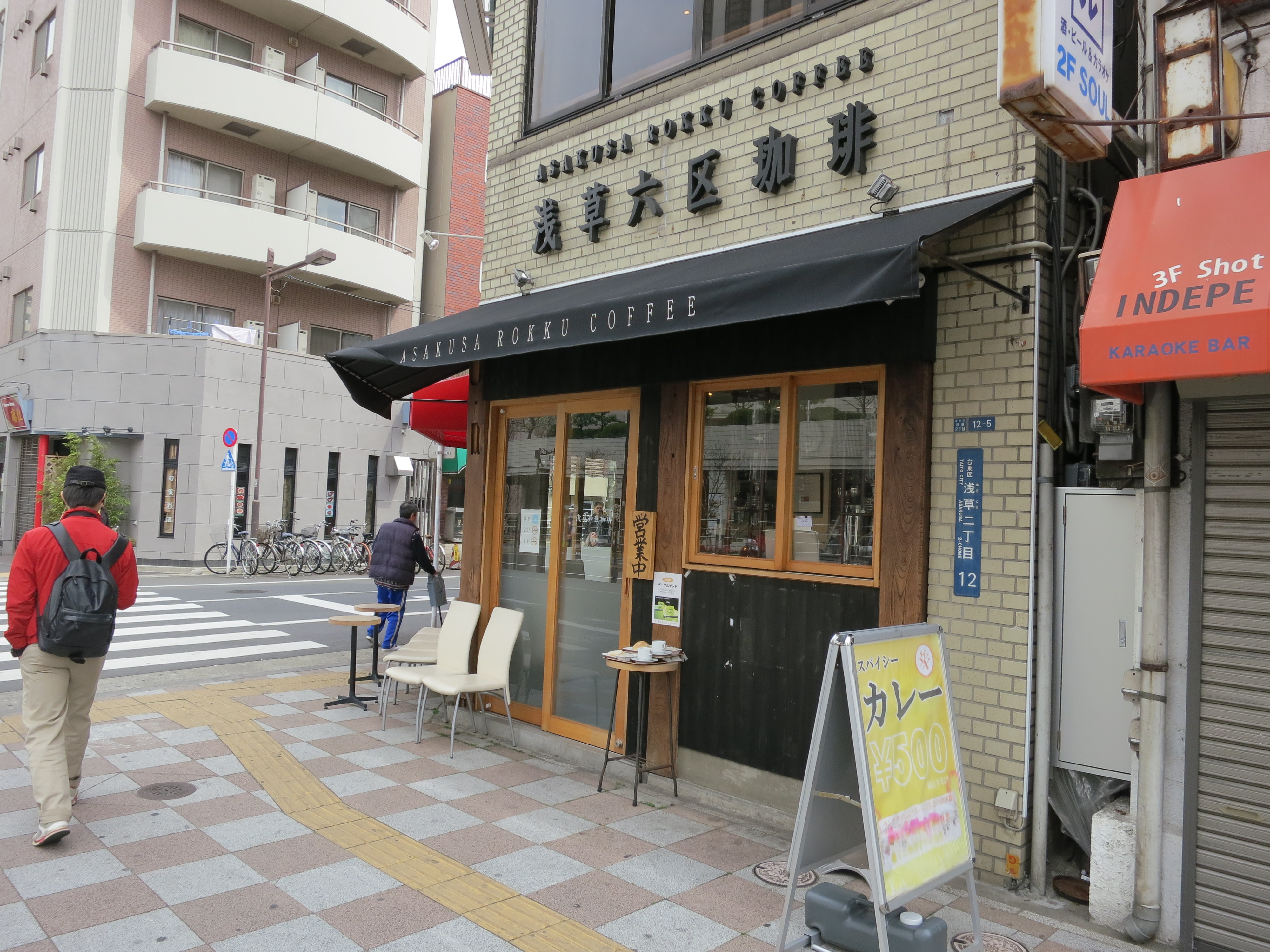
Both the coffee and the hot cocoa are excellent if you happen to be in the neighborhood.
That’s more or less the end of the story. The exchanges at the hospital were regrettable–after all, as I mentioned previously, we do everything we can to conduct ourselves with decorum while visiting Japan. On the other hand, the disorganization and lack of attention in the emergency room was appalling, and had Tracie not been carrying an EpiPen, this story might well have ended quite differently. I’m not proud to say that we had to resort to Loud American mode (albeit highly educated Loud American mode) to get the care that Tracie needed, including getting us out of the hospital after remaining there was doing more bad than good. I am, however, proud to say that I saved her life that evening in the emergency room in Kobe, when continuing to be quiet Americans probably wouldn’t have done so.
EpiLog
On the day before our departure, we were sitting in the Dotour in Ginza, having a conversation about stress management, when one of Tracie’s dental crowns fell out.
No, I’m not kidding.
I’m sad to say that I had the worst physical reaction to stress that I’ve had in many years; all I could think was, “oh, no, NOW what?” However, Tracie managed to stick it back in and keep it there, and then, via a series of phone messages and emails (since Japan time is 15 hours ahead of Boulder time), we were able to arrange an appointment with our dentist for the day after we got back.
We also heard later that day that a severe snow storm was expected to hit the Denver/Boulder region on the day we were flying home. This meant the possibility of cancelled flights, impassable highways, etc. Fortunately the storm wasn’t as bad as expected, and fortunately its only affect on our trip home was to delay our connecting flight between Seattle and Denver. This was a good thing because, had the flight left on time, we probably would have missed it.
When we finally pulled up in the driveway at home, I felt that I was more in need of a vacation then than I was on the day that we departed. A few days later I still think that’s the case.

I hope you guys have time in your returned-home schedule to recover from your vacation… Well done finding the good bits in what sounds like a terrifying sequence of epic proportions. After the narrative from a previous trip, I’d let myself think that medical care in Japan was a non-concern.
I wonder whether and how the other issues you had in Kobe would have been without the language barrier… Are they always that disorganized?
In any case, this does also re-confirm that you both possess remarkable coping skills, and that Tracie is a phenomenal badass. I’m glad everyone’s on the “makes you stronger” side of that hackneyed dilemma…
We’re gradually rallying ourselves. There have been further challenges since our return which I won’t go into right now, but I can at least say that I think I’m now pretty much back in this timezone.
Regarding the hospital in Kobe: it’s a fair question. I’d like to give them the benefit of the doubt and say that things would have been better without the language barrier. However, we’ve now visited three hospitals in Japan (the post you’re thinking of is here) and the one in Kobe distinguished itself with its lack of attention. There was a stark contrast between how we were handled upon arriving there vs. how we were handled upon arriving at the hospitals in Tokyo and Takayama. So, just like in the US, the quality of emergency medical care seems to vary with location. It’s a relevant point that Tracie asked the doctor in the ER in Boulder whether her (first) reaction could have been carbamazepine, and he emphatically said no.
Anyway, thanks. Tracie is indeed a phenomenal badass.
A phenomenal badass honey badger!
Y’all’s hospital experiences were not out of line with the norm here but I’ll say you were VERY lucky to get directly into Tokyo University Hospital so quickly. Last time I needed to get in there it required a letter of referral and a couple weeks to get the appointment.
Also count yourselves EXTREMELY lucky you didnt have to deal with a dentist here for the broken crown. I dont even want to tell you the horror stories of Japanese dentistry.